I am a PhD student at the LIO laboratory (Laboratoire d'innovation ouverte en technologies de la santé) at ÉTS Montréal,
working at the intersection of computer vision and biomechanics. My research focuses on human pose
estimation and its application to markerless motion analysis.
I also developed some tools, like a
pose estimation framework to address the reproducibility problem deep-learning tasks.
🔥 News
May 2026 Presented our preprint Context-aware 3D gait pose estimation via lightweight multi-scale features sampling at the MonMIND 2026 Workshop 14-04-2026 Presented PhD research areas @KITE Lab (University of Toronto) for the journal club of Babak Taati Sep 2025 Recipient of the Young researcher Mobility Scholarship 2025 from the French Society of Biomechanics.
Sep 2024 Lab instructor for GT411 — Digital Imaging, ÉTS Montréal.
May 2024 Recipient of the excellence grant for scientific communication activities — ÉTS Library.
📓 Publications
Effect of markers in training dataset for markerless applications in biomechanics
Mercier L.,Cresson T. ,Gervais S. ,Mezghani N. ,Vázquez C. ,
Journal of Biomechanics
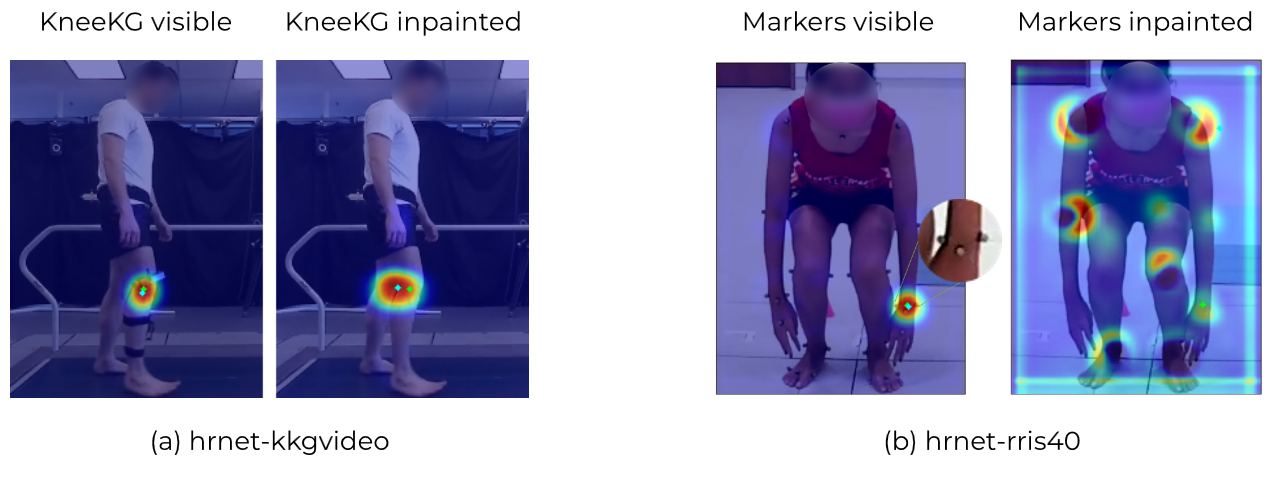
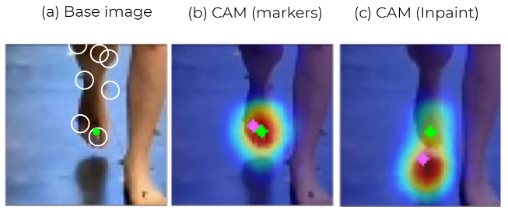
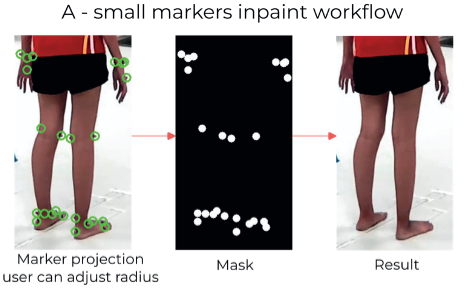
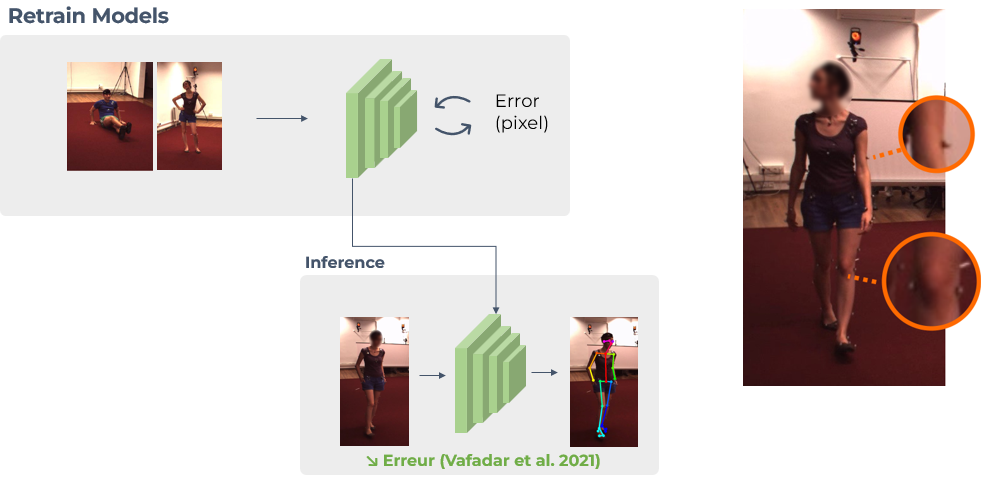
We formally demonstrate that when pose estimation model are trained with visible markers, the model learns to detect the markers rather than the actual human anatomy. We developed an inpainting pipeline using a GAN-based model (LaMa) to remove markers from test images. By using Class Activation Maps (CAM), we showed that the network's attention focuses heavily on markers when they are visible.
Published abstracts
Investigating reflective marker impact in a multi-camera markerless motion capture scenario.
Mercier L.,Gajny L. ,Cresson T. ,Mezghani, N. ,Vázquez, C. ,
Congress of the French society of biomechanics · Montpellier, France 2026
We extend our previous work on marker impact in training pose estimation model to multi-camera markerless motion capture scenario. In that case MPJPE (mm) increases by up to +40% when markers are removed.
Using knee kinesiography to train markerless pose estimation models for first-line kinematic assessment in knee osteoarthritis
Mercier L.,Marois B. ,Fuentes A. ,Cagnin A. ,Cresson T. ,Vázquez, C. ,
OARSI World Congress on Osteoarthritis · Palm Beach, USA 2026
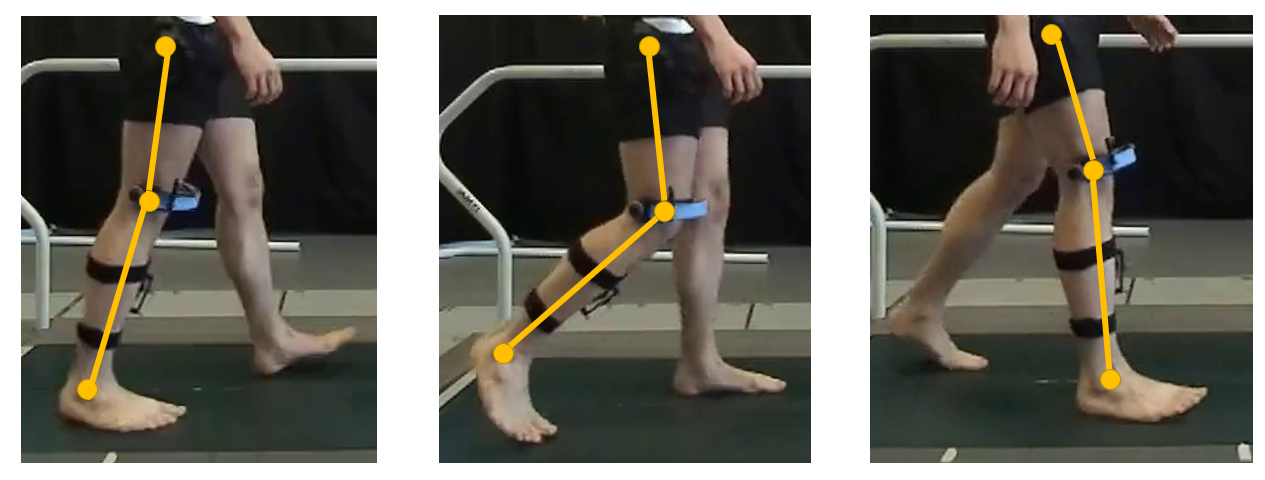
Off-the-shelf pose estimation models reported limited precision to estimate sagittal knee kinematics. results further suggest that the available models are insufficient to estimate knee OA relevant markers, failing to meet required clinical accuracy. Retraining them on a clinicaly validated system, the KneeKG, significantly improved models' accuracy to achieve within-to-close clinically acceptable threshold.
Framework for the application of markerless motion capture to biomechanics
Mercier L.,Cresson T. ,Mezghani N. ,Vázquez C. ,
Congress of the French society of biomechanics · Marseille, France 2025
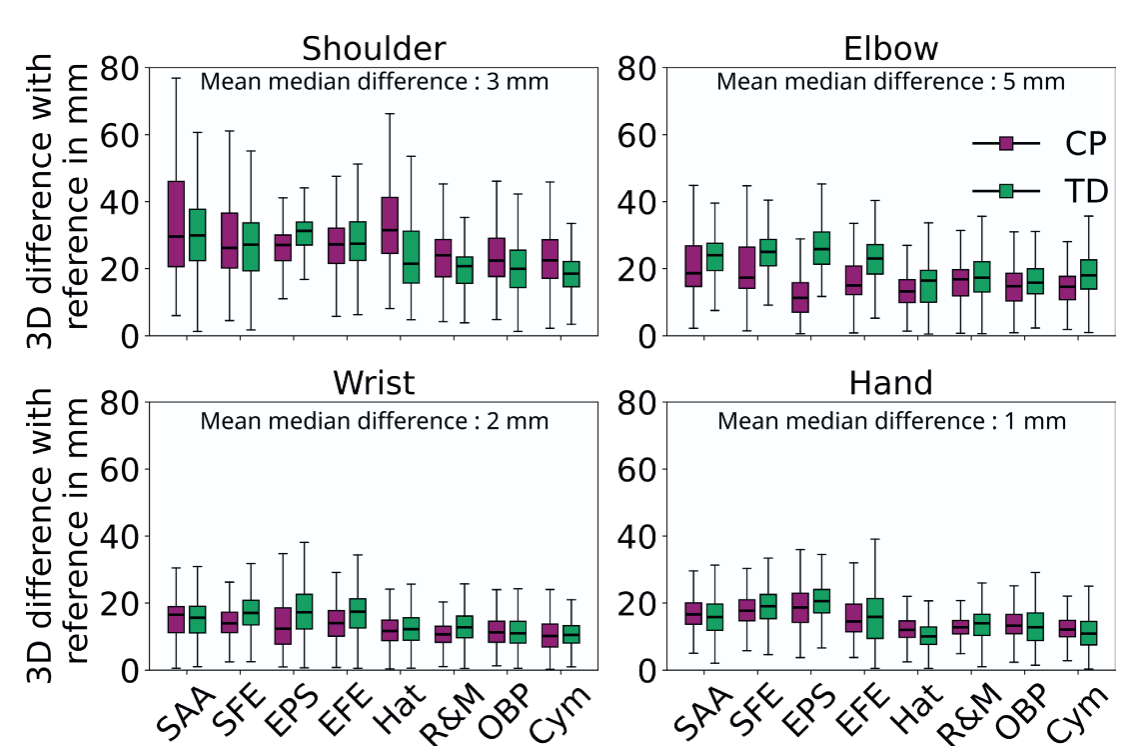
Markerless motion capture accuracy in children with cerebral palsy and typically developing children
Naaïm A. ,Rozaire J. ,Mercier L.,Begon M. ,Cherni Y. ,
Congress of the French society of biomechanics · Marseille, France 2025
Conference presentations
Evaluation of 3D marker-less motion capture precision in upper limb children movement
Naaim A. ,Rozaire J. ,Mercier L.,Duprey S. ,Begon M. ,
International Society of Biomechanics · Stockholm, Sweden · 2025
Oral
Étude de l'impact de la présence des marqueurs pour l'estimation de la pose humaine
Mercier L.,Cresson T. ,Mezghani N. ,Vázquez C. ,
92e Congrès de l'Acfas · Montréal, Canada · 2025
Awards & grants
2025 Mobility Scholarship at Institut de Biomécanique Humaine Georges Charpak
Société de Biomécanique (International French-speaking Society of Biomechanics)
2024 Excellence grant for scientific communication activities
ÉTS Library
🏫 Teaching
Fall 2024, Winter 2025, Fall 2025 - 107 hours total
Mini Lightroom - contrast, curves, color spaceRoad sign detection - classical CV, no deep learningReal-time background removal - non-DL segmentation